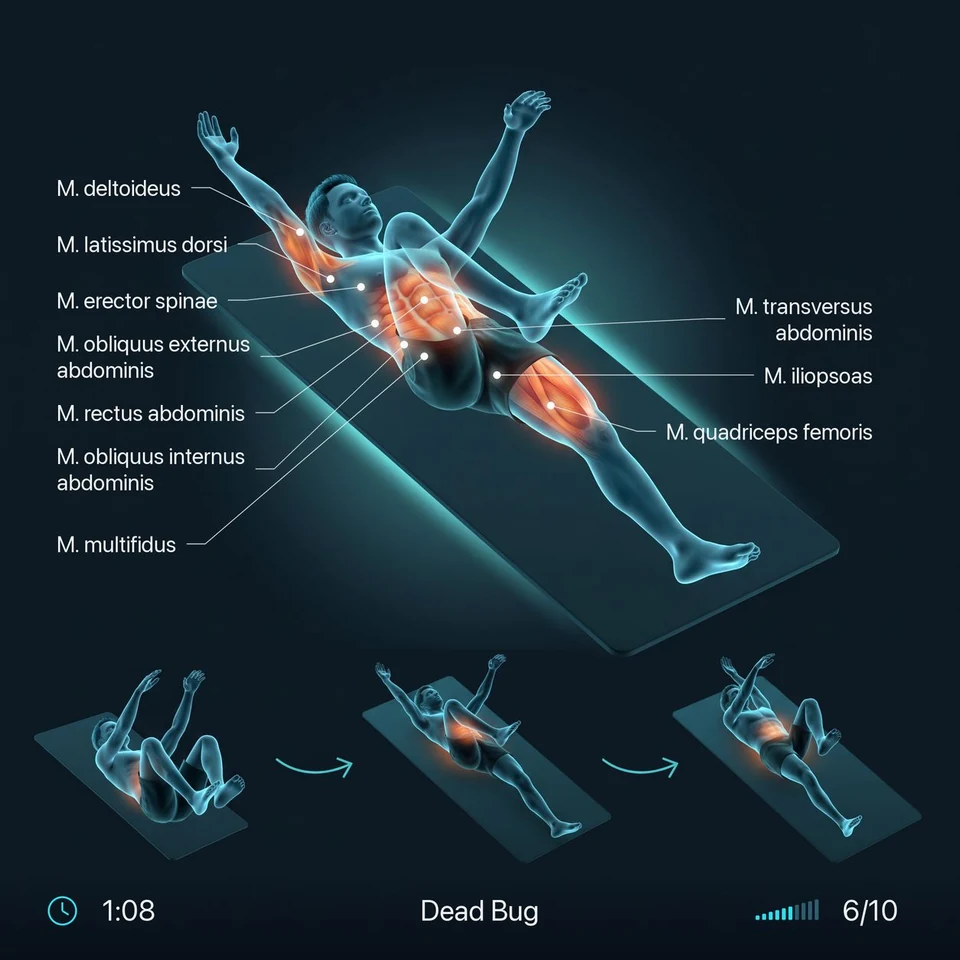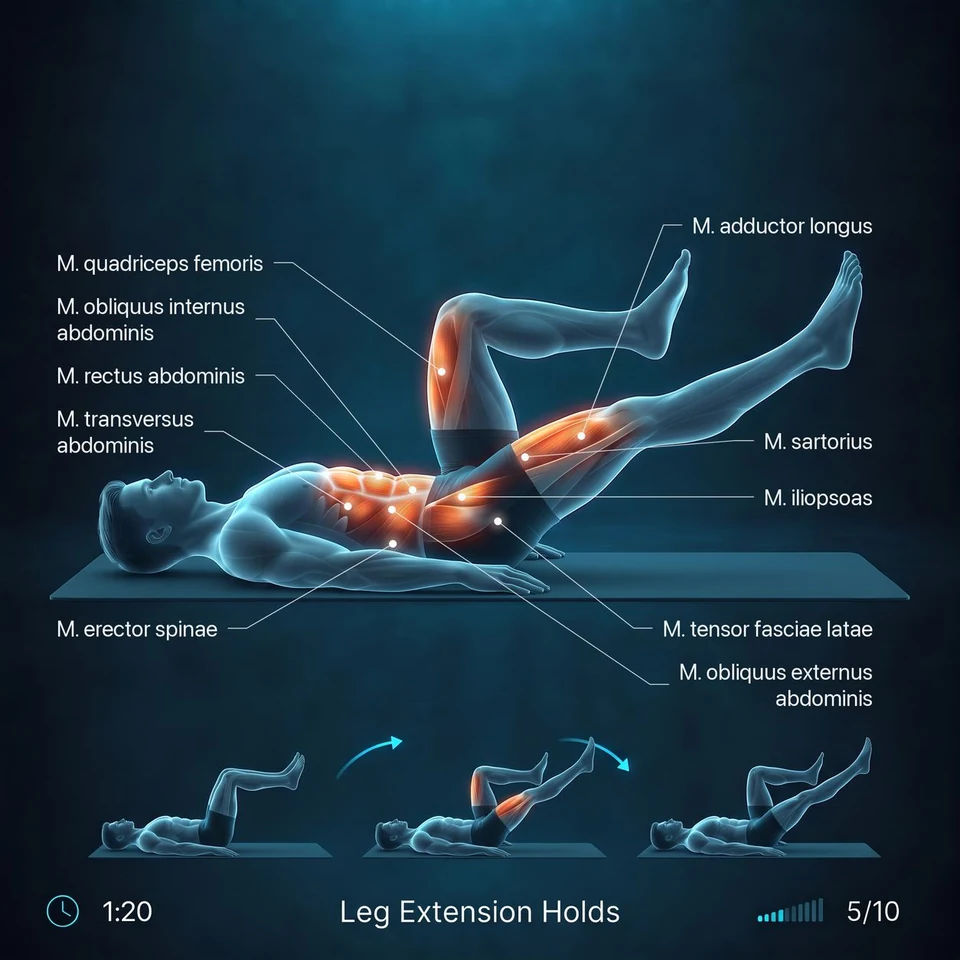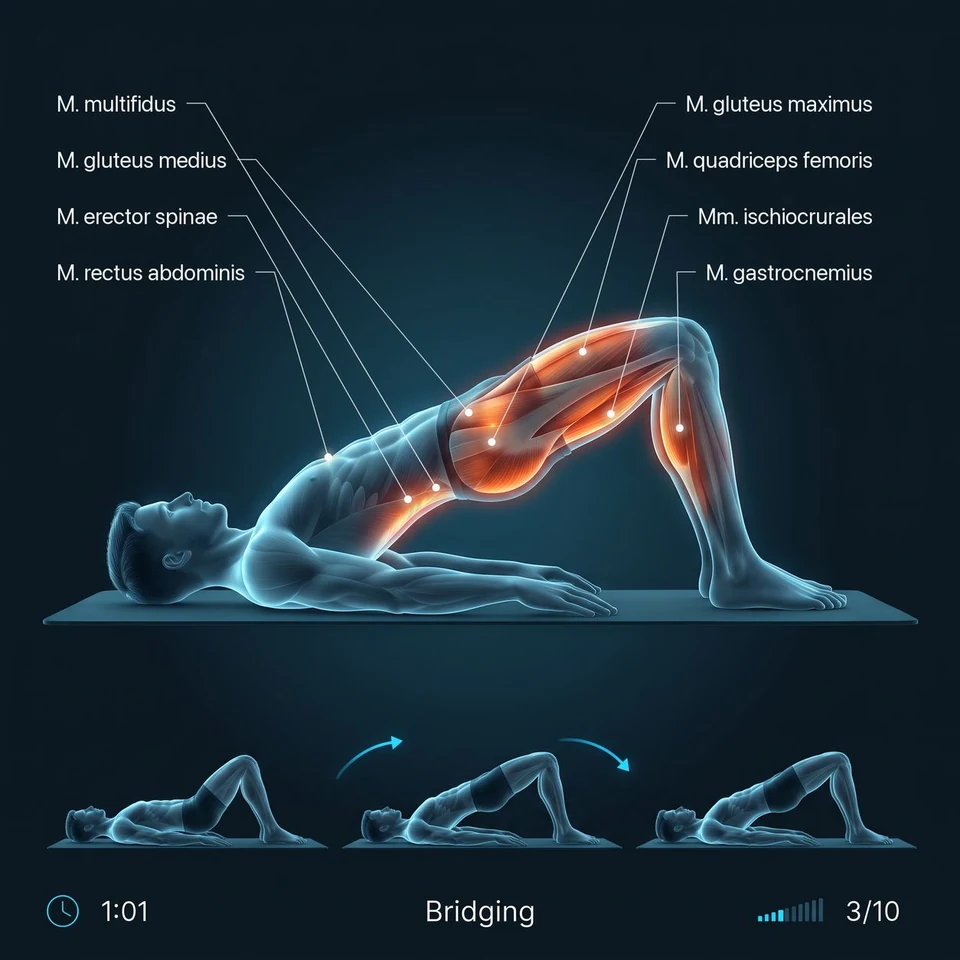
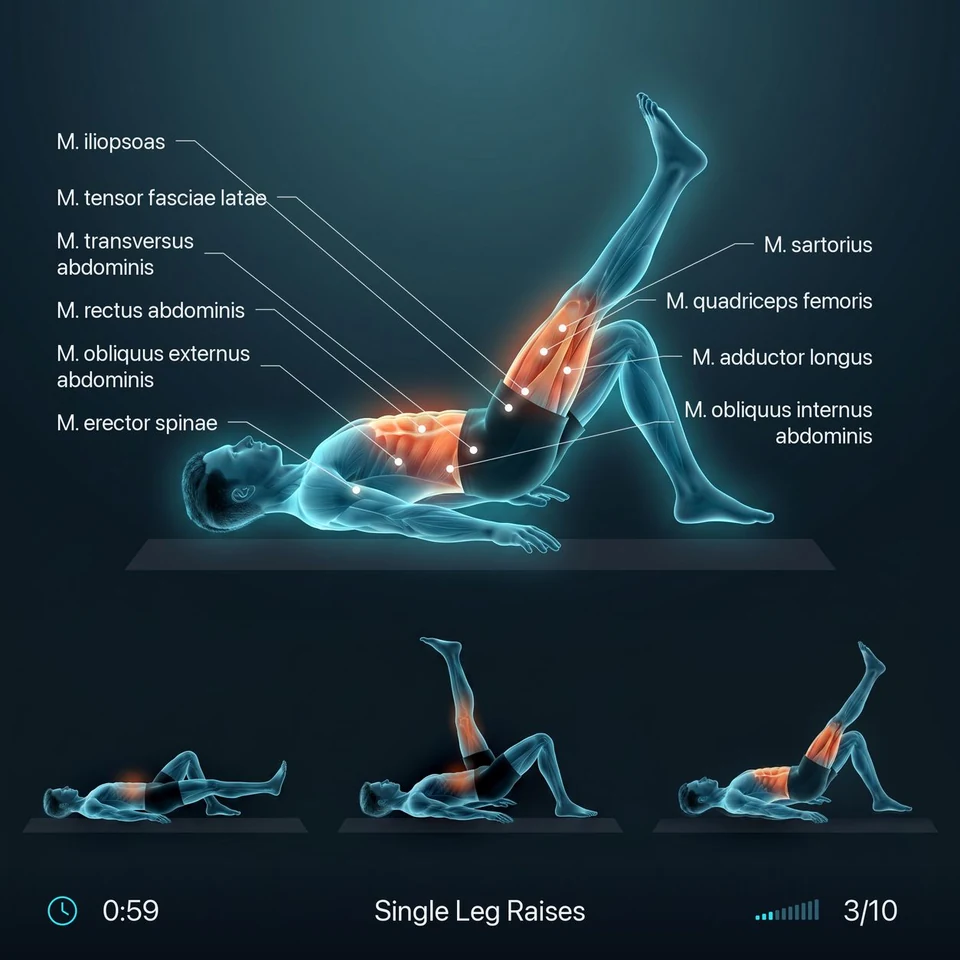
Core & Pelvis

Pelvic Tilt

  • 1:21 min
  • 🔊 Voice guidance
  • AR AR available

Pelvic Tilt: Starting position: Supine. The public 3D demo shows the recorded movement with voice guidance.

Before you start · Supports your training. No individual suitability assessment.

The exercise in detail

It is performed mostly lying on your back — the movement comes calmly and controlled from your center.

How the exercise works

  1. Starting position

    Lie flat on your back with your knees bent and your feet hip-width apart on the floor. Your arms rest relaxed at your sides.

  2. Slowly press your lower back flat into the floor by tilting your pelvis backward and engaging your abdominal muscles.

  3. Feel the deep abdominal muscles activate and hold this position for a few seconds.

  4. Slowly release the tension by returning your pelvis to the neutral position.

  5. Repeat the movement with control and slowly.

  6. Repetitions

    Perform the movement continuously for 1 minute, maintaining tension in the abdominal muscles.
At a glance

Difficulty
3 of 10
Recommended duration
1 minute
Position
Supine
3D clip
01:03 min

Muscles trained

  • Transversus abdominis (transverse abdominal muscle)
  • Rectus abdominis (straight abdominal muscle)
  • Obliquus internus abdominis (internal oblique)
  • Obliquus externus abdominis (external oblique)
  • Erector spinae (back extensor)

Description

The 'Pelvic Tilt' is a basic yet effective exercise for strengthening the deep abdominal muscles and stabilizing the lumbar spine. It is used as conditioning for the back and can help improve mobility in the pelvic area.

Tips

  • Perform the movement slowly and with control to activate the muscles optimally.
  • Keep your neck relaxed and avoid lifting your head too much.
  • Breathe in deeply as you release the tension, and exhale slowly as you tilt your pelvis into the floor.

Variations

Harder
During the tilting movement, raise one leg slightly to increase the stability challenge.
Easier
Reduce the range of motion by tilting your pelvis only slightly to make the exercise easier.

Classification

Training name
Pelvic Tilt Training

When to be careful

Skip this exercise or check with your doctor or physical therapist first if any of these apply to you:

  • Acute back injuries
  • Severe lumbar spine instability
  • Uncontrolled muscle spasms in the back
  • Recent surgery in the trunk area

What this exercise is intended for

  • Conditioning for the back
  • Improved mobility in the pelvic area
  • Strengthening of the deep abdominal muscles
  • Stabilization of the lumbar spine

Information from the Physio3D app exercise catalog — not a medical claim or promise of results.

Related exercises

This exercise in the app

All 50 exercises, plus training plans and your progress at a glance — free for iPhone, iPad, and Apple Vision Pro.

Physio3D is a supportive training tool and does not replace medical advice, diagnosis, or therapy. If you have any health concerns, please consult a doctor or physical therapist.

Exercise

Loading character …

Physio3D is a supportive training tool and does not replace medical advice, diagnosis, or therapy. If you have any health concerns, please consult a doctor or physical therapist.

Exercise

Physio3D is a supportive training tool and does not replace medical advice, diagnosis, or therapy. If you have any health concerns, please consult a doctor or physical therapist.