Core & Pelvis

Dead Bug

  • 1:25 min
  • AR 3D / AR in the apps

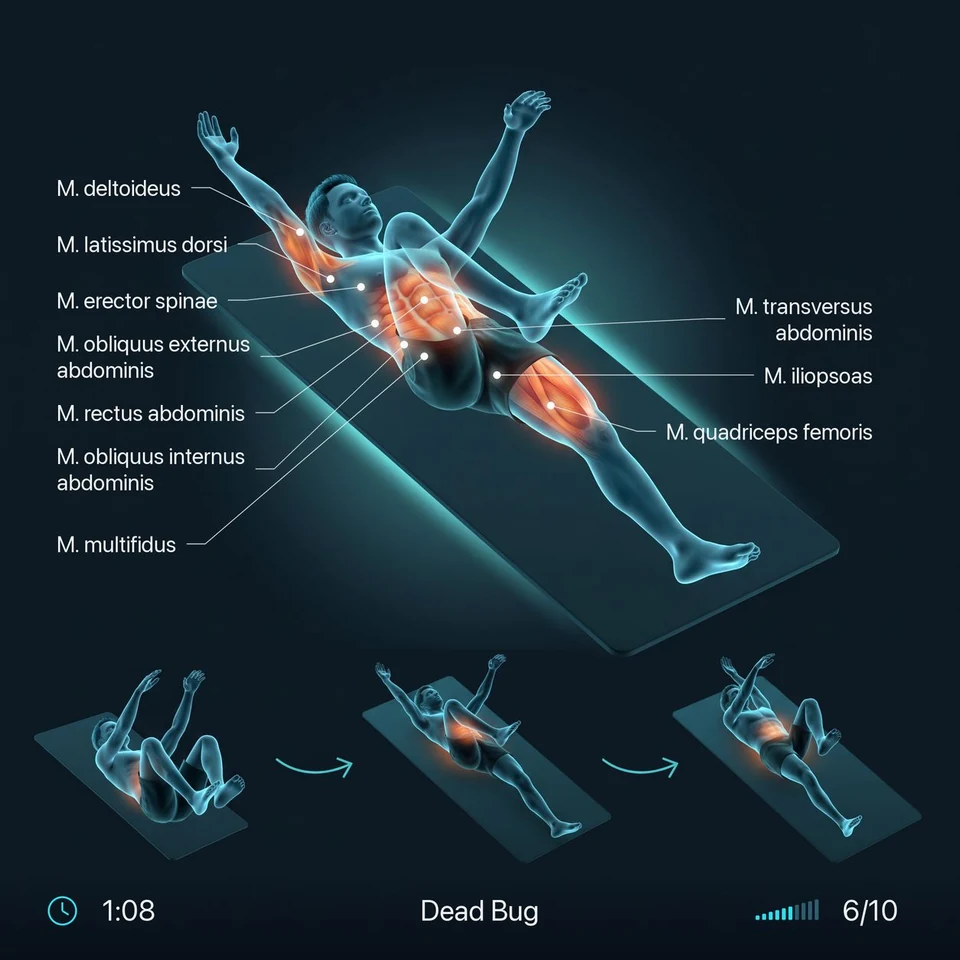
Dead Bug: Starting position: Supine. The full 3D and AR demonstration is available in the Physio3D apps. Read the exercise instructions here.

Before you start · Supports your training. No individual suitability assessment.

Find this exercise in 3D and AR in the Physio3D apps. Read the instructions and exercise information here. Find your app

The exercise in detail

It is performed mostly lying on your back — the movement comes calmly and controlled from your center.

How the exercise works

  1. Starting position

    Lie flat on your back with your knees bent at a 90-degree angle so that your shins are parallel to the floor. Raise both arms so they point straight up toward the ceiling, palms facing inward.

  2. Engage your abdominal muscles by pressing your lower back flat into the floor.

  3. Breathe in deeply and, as you exhale, slowly extend your right leg forward while simultaneously reaching your left arm back overhead, so that both limbs almost touch the floor but do not rest on it.

  4. Make sure your lower back stays flat on the floor and does not arch upward.

  5. Perform the movement with control and hold the end position for a moment.

  6. Then return your leg and arm to the starting position and repeat the movement with your left leg and right arm.

  7. Repetitions

    Continue alternating in rhythm until the minute is up, always keeping control of the movements in your lower back.
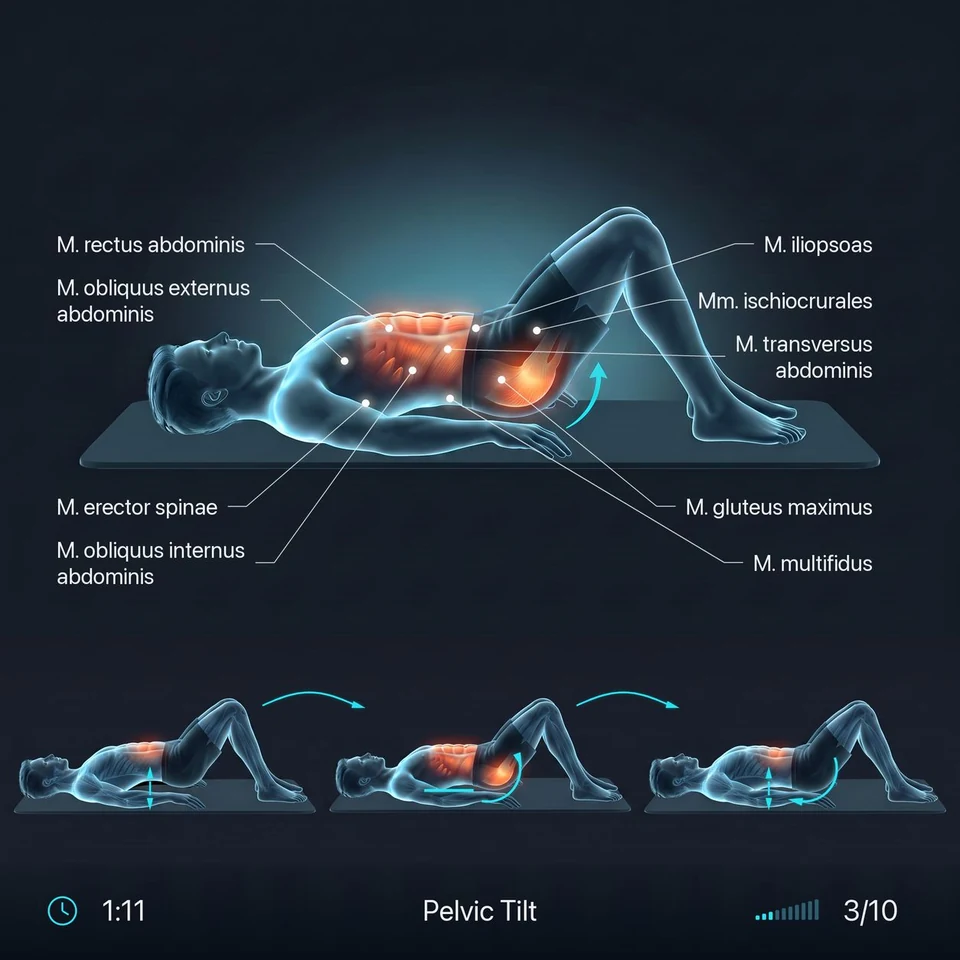
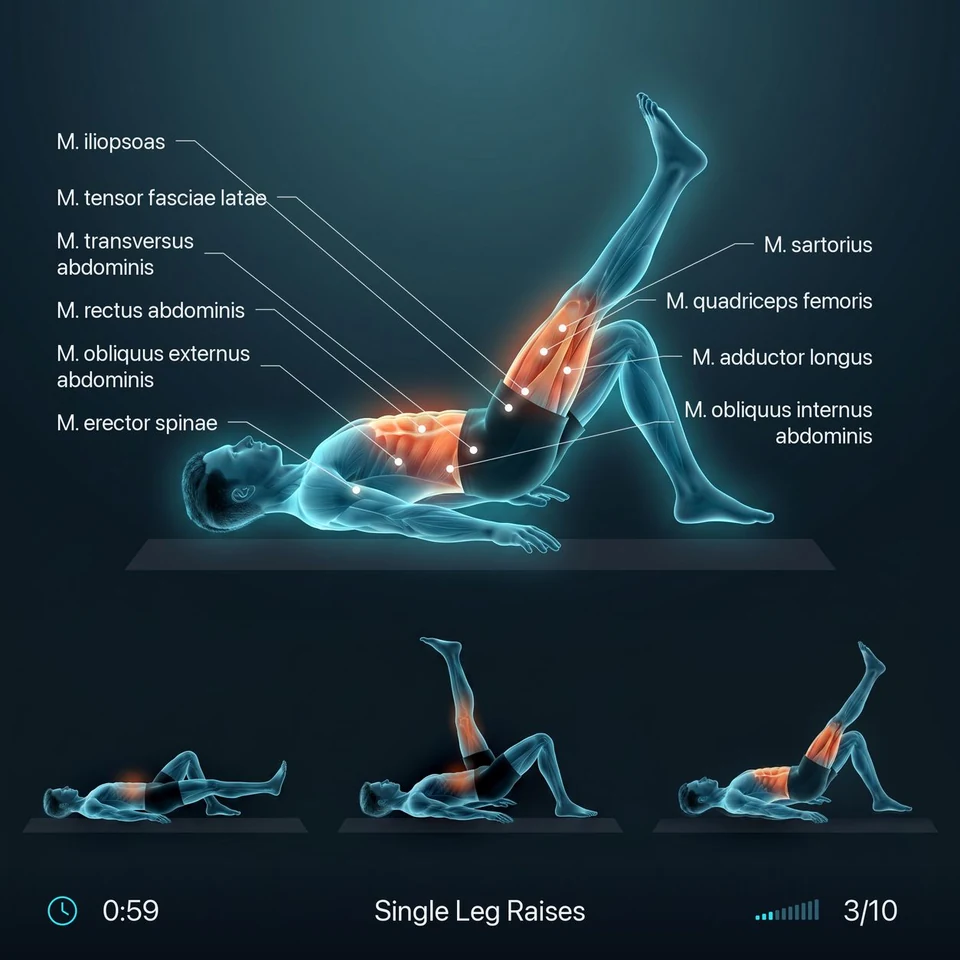
At a glance

Difficulty
6 of 10
Recommended duration
1 minute
Position
Supine
3D clip
01:24 min

Muscles trained

  • Rectus abdominis (straight abdominal muscle)
  • Transversus abdominis (transverse abdominal muscle)
  • Obliquus externus abdominis (external oblique)
  • Obliquus internus abdominis (internal oblique)
  • Iliopsoas (hip flexor)

Description

The Dead Bug is an effective exercise for strengthening the core muscles and improving the stability of the lumbar spine. This exercise promotes coordination between arm and leg movements while stabilizing the spine.

Tips

  • Keep your lower back pressed flat into the floor throughout the exercise to ensure a stable base.
  • Move your limbs slowly and with control to maintain tension in the core muscles.
  • Breathe evenly and calmly to support the movement and stabilize the muscles.

Variations

Harder
Extend both legs forward at the same time while reaching both arms back. This demands more control and increases the load on the core muscles.
Easier
Perform the exercise with bent knees so that your feet stay closer to your body. Alternatively, perform the movement with only the arms or only the legs to simplify the exercise.

Classification

Training name
Dead Bug Training

When to be careful

Skip this exercise or check with your doctor or physical therapist first if any of these apply to you:

  • Acute back injuries
  • Severe lumbar spine instability
  • Uncontrolled muscle spasms in the back
  • Recent surgery in the trunk area
  • Acute pain during the exercise

What this exercise is intended for

  • Improved deep stability of the lumbar spine
  • Strengthening of the abdominal muscles
  • Improved coordination between arm and leg movements
  • Conditioning, especially for the lower back

Information from the Physio3D app exercise catalog — not a medical claim or promise of results.

Related exercises

This exercise in the app

All 50 exercises, plus training plans and your progress at a glance — free for iPhone, iPad, and Apple Vision Pro.

Physio3D is a supportive training tool and does not replace medical advice, diagnosis, or therapy. If you have any health concerns, please consult a doctor or physical therapist.

Exercise

Physio3D is a supportive training tool and does not replace medical advice, diagnosis, or therapy. If you have any health concerns, please consult a doctor or physical therapist.