“Two to three times a week, daily if you can” — if you’ve ever been in physical therapy, you know the home exercise assignment. And yet the exercise sheet tends to hang on the fridge until the next appointment rolls around. Why? It’s rarely about willpower. At home, three things are missing that make exercising at the clinic feel so natural: clear guidance, a fixed time slot, and someone who’s paying attention.
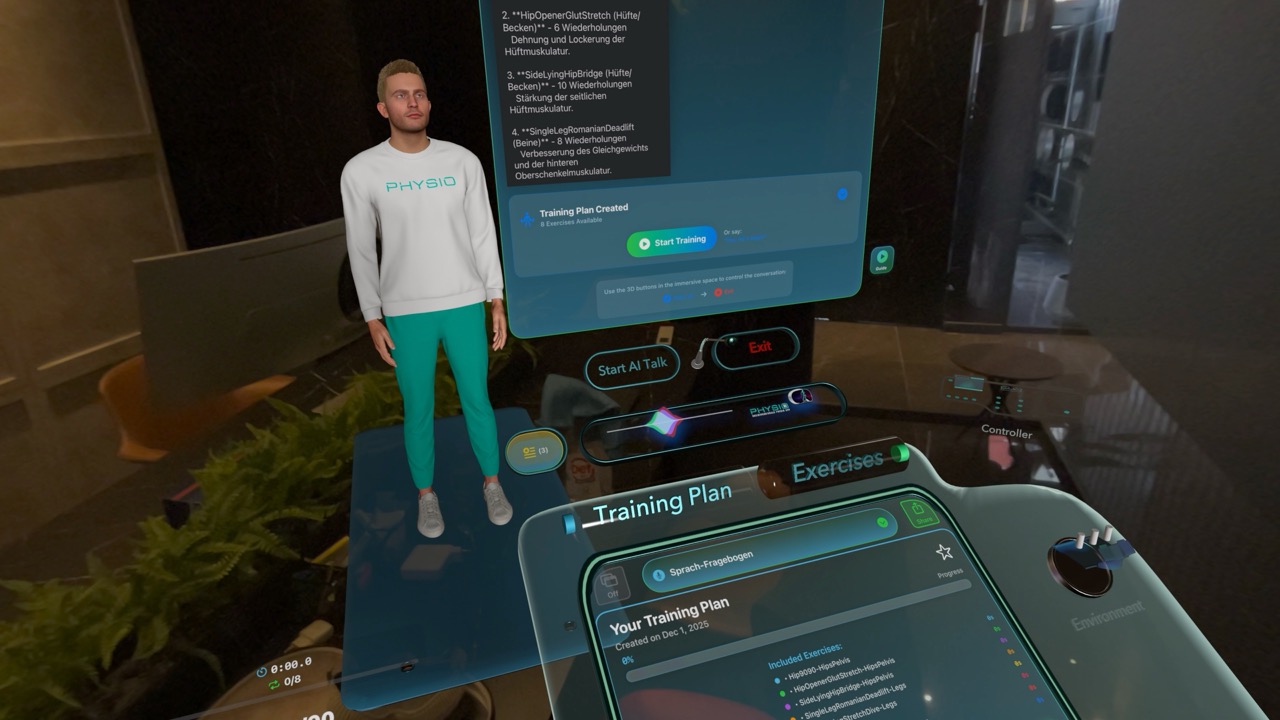
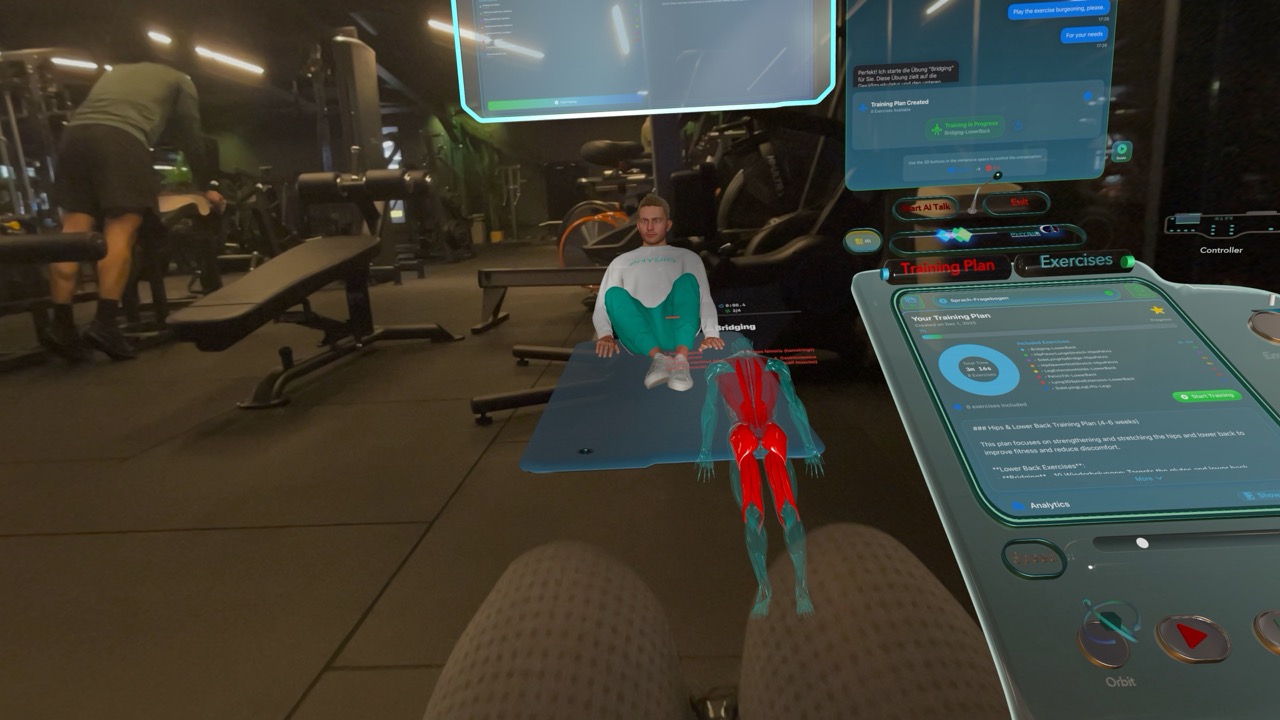
Those are exactly the gaps a good exercise app can fill. It shows every movement in a way you can truly follow — in Physio3D as a lifelike 3D model instead of a stick figure on paper. It gives your training a fixed place in your day, with a plan, reminders, and routine. And it keeps track of what you’ve done, so progress becomes visible instead of staying a vague feeling.
One thing up front: an app doesn’t replace physical therapy. It helps with the part between appointments — staying consistent. But that’s exactly where the fate of your exercise program is decided.
Why is exercising at home so hard?
Four reasons come up again and again in conversations with patients:
Uncertainty. “Am I even doing this right?” Without feedback, every rep feels like guessing — and what feels uncertain is easy to put off.
Unclear instructions. The photocopied exercise sheet shows two photos and an arrow. What happens between the start and end positions, at what pace, with what posture — that’s left to your memory of the last appointment.
No fixed place in your day. At the clinic, there’s an appointment on the calendar. At home, your exercise program competes with everything else — and loses that competition surprisingly often.
Invisible progress. Change comes in small steps. If you don’t record them, you barely notice them — and without visible progress, you’re missing the strongest motivator there is.
What makes a good exercise app?
Measured against these four hurdles, the answer becomes clear. A good exercise app isn’t a video collection with a search box — it’s a tool that closes exactly the gaps where home exercising fails:
Guidance you can understand. A movement in 3D — from every angle, at your pace — is a different thing than a photo. For Physio3D, all 50+ exercises were recorded with professional motion capture at a studio in Cologne: real, cleanly executed movements, precisely transferred onto a 3D coach.
A plan instead of loose exercises. Whether you import your therapist’s plan as a PDF or build your own: a structured training plan with clear sessions turns “I really should get to it” into “session 3 is on today.” That gives exercising the fixed spot on the calendar it naturally has at the clinic.
Visible progress. Activity tracking shows you in black and white what you’ve already completed — depending on the app, from a clean KPI dashboard with a training streak to more than 20 training metrics on Apple Vision Pro. A checked-off training week is often motivation enough for the next one.
A low barrier to entry. The three Physio3D apps are free on the App Store, with no subscription — trying them costs you nothing but a few minutes.
How does voice control help you stay consistent?
Every interruption is an invitation to stop. If you have to unlock your device mid-exercise, find the app, and tap through menus, you lose focus and momentum — and sometimes the whole session.
With Physia AI, you just say what you need: “Start my plan for today.” “What was the starting position again?” “What’s the next exercise?” The AI voice coach answers in real time — your hands stay free, your focus stays on the movement. Especially when training at home, without a mirror or a professional nearby, that makes a real difference to your flow.
Does an app replace physical therapy?
No — and it’s not supposed to. Diagnosis, assessment, and treatment belong in the hands of your doctor or therapist. An exercise app is a supportive tool for the time in between: it reminds, shows, documents, and motivates — complementing your therapy, never replacing it.
That’s exactly how Physio3D sees itself: as a companion between appointments, hand in hand with your therapist. Physio3D doesn’t replace medical advice or diagnosis.
Bottom line: staying consistent can be made easier
When home exercise programs fizzle out, it’s rarely about discipline — it’s about uncertainty, unclear instructions, and missing routine. A good exercise app tackles precisely those points: understandable 3D guidance, a structured plan, visible progress, and controls that stay out of your way.
Discover the three Physio3D apps — and find out which one fits your daily routine.