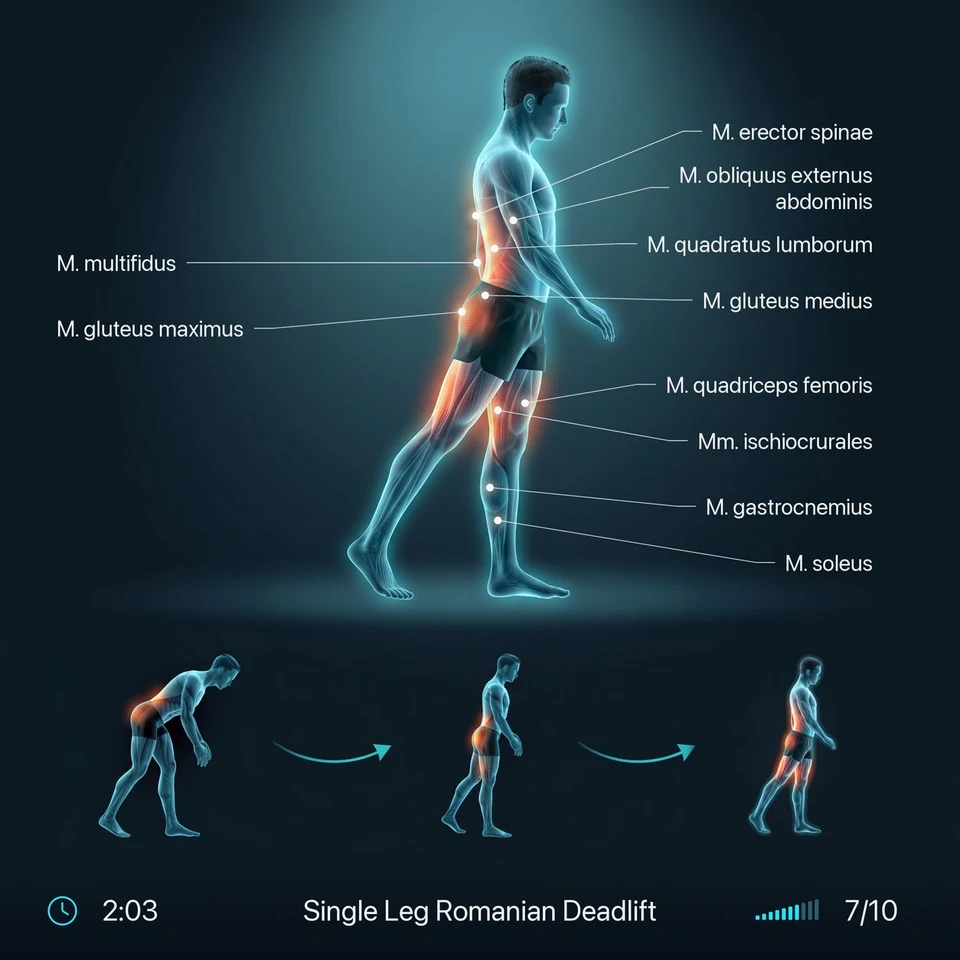
Strength & Lower Body

Single Leg Dead Lift

  • 2:07 min
  • AR 3D / AR in the apps

Single Leg Dead Lift: Starting position: Standing. The full 3D and AR demonstration is available in the Physio3D apps. Read the exercise instructions here.

Before you start · Supports your training. No individual suitability assessment.

Find this exercise in 3D and AR in the Physio3D apps. Read the instructions and exercise information here. Find your app

The exercise in detail

Legs, glutes, and core work together; the pace stays deliberately calm and controlled.

How the exercise works

  1. Starting position

    Stand upright on your right leg. The standing leg is submaximally extended, and the left leg is set down slightly behind you, with only the toes touching the floor.

  2. Slowly bend your upper body forward while the standing leg stays slightly bent.

  3. The back leg stays in its set-down position without putting pressure on the floor.

  4. Lower your upper body until you feel a slight stretch in the hamstrings.

  5. Hold the position briefly and then return to the starting position with control.

  6. Repetitions

    Perform the exercise for 1 minute, switching legs after 30 seconds.
At a glance

Difficulty
7 of 10
Recommended duration
1 minute
Position
Standing
3D clip
02:06 min

Muscles trained

  • Gluteus maximus (large gluteal muscle)
  • Biceps femoris (knee flexor)
  • Erector spinae (back extensor)
  • Gastrocnemius (calf muscle)
  • Quadratus lumborum (deep lower-back muscle)

Description

The single-leg deadlift with the back leg set down and the standing leg submaximally extended is a demanding variation that both strengthens the posterior chain and improves balance and stability. The standing leg stays almost straight but not fully locked out, to protect the joints and intensify the muscle work. This exercise is excellent for improving stability and coordination.

Tips

  • Make sure your hip stays stable and your back stays in a neutral position.
  • Keep your weight on the heel of the standing leg.
  • Inhale as you lower your upper body, and exhale as you stand back up.

Variations

Harder
Perform the exercise with a dumbbell or kettlebell in your hand to increase the resistance. Easier: reduce the depth of the forward bend or hold onto a wall or chair lightly to support your balance.

Classification

Focus areas
Trunk, lower body, balance
Training name
Single Leg Romanian Deadlift Training

When to be careful

Skip this exercise or check with your doctor or physical therapist first if any of these apply to you:

  • Acute knee or back injuries
  • Severe instability in the knee or ankle joint
  • Acute pain during the exercise
  • Recent surgery on the lower body

What this exercise is intended for

  • Improved single-sided leg and gluteal strength
  • Increased balance and stability in the knee and ankle joints
  • Promotion of core stability and back strengthening
  • Improved posture by strengthening the posterior chain

Information from the Physio3D app exercise catalog — not a medical claim or promise of results.

Related exercises

This exercise in the app

All 50 exercises, plus training plans and your progress at a glance — free for iPhone, iPad, and Apple Vision Pro.

Physio3D is a supportive training tool and does not replace medical advice, diagnosis, or therapy. If you have any health concerns, please consult a doctor or physical therapist.

Exercise

Physio3D is a supportive training tool and does not replace medical advice, diagnosis, or therapy. If you have any health concerns, please consult a doctor or physical therapist.