Strength & Lower Body

3DSquat

  • 1:01 min
  • 🔊 Voice guidance
  • AR AR available

3DSquat: Starting position: Standing. The public 3D demo shows the recorded movement with voice guidance.

Before you start · Supports your training. No individual suitability assessment.

The exercise in detail

Legs, glutes, and core work together; the pace stays deliberately calm and controlled.

How the exercise works

  1. Starting position

    Stand hip-width apart with your feet parallel to each other. Squeeze your shoulder blades back and down together to lift the thoracic spine. Cross your arms in front of your chest.

  2. Initiate the rotation of the spine through your chin by turning your chin toward your armpit.

  3. At the same time, begin to slowly move into the squat.

  4. Your upper body follows the head movement.

  5. Go as deep into the squat as is pain-free while allowing your upper body to fully rotate.

  6. Slowly come back up out of the squat, again initiating the movement through your chin.

  7. Look in the opposite direction toward the ceiling as you stand up.
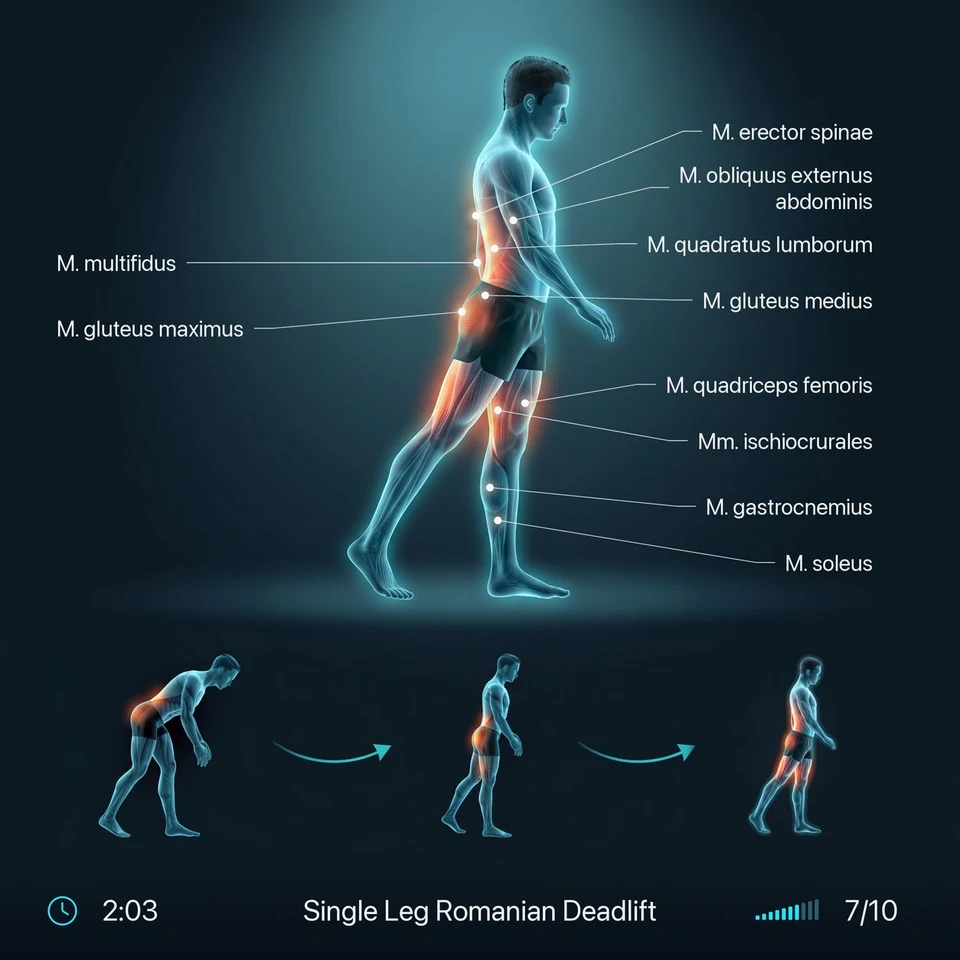
At a glance

Difficulty
8 of 10
Recommended duration
1 minute
Position
Standing
3D clip
01:01 min

Muscles trained

  • Lower body:
  • Quadriceps femoris (front of the thigh)
  • Gluteus maximus (large gluteal muscle)
  • Hamstrings (back of the thigh)
  • Adductor longus, brevis, magnus (adductors)
  • Gastrocnemius (calf muscle), upper body and trunk:
  • Erector spinae (back extensor)
  • Rectus abdominis (straight abdominal muscle)
  • Obliquus externus and internus abdominis (oblique abdominal muscles)
  • Trapezius (trapezius muscle)
  • Deltoideus (shoulder muscle)

Description

The '3D Squat' is a complex functional exercise that combines all three movement directions of the spine (flexion, extension, side bending) with a squat. This exercise trains the muscles of both the lower and upper body while promoting the mobility and stability of the spine.

Tips

  • Make sure your knees stay stable and do not move inward or outward.
  • Keep your back straight throughout the movement to protect the spine.
  • Perform the movements slowly and with control to challenge the muscles optimally.

Variations

Harder
Hold light dumbbells in your hands or perform the exercise on an unstable surface to increase the difficulty.
Easier
Reduce the depth of the squat or perform the exercise without rotation to lower the load.

Classification

Focus areas
Lower body, trunk, upper body
Training name
3D Squat Training

When to be careful

Skip this exercise or check with your doctor or physical therapist first if any of these apply to you:

  • Acute injuries of the lower body or spine
  • Inflammatory joint conditions, especially of the knees, hips, or spine
  • Severe herniated discs or acute nerve compression symptoms
  • Severe osteoporosis due to the increased fracture risk
  • Unstable cardiovascular conditions in which heavy loads should be avoided
  • Recent joint replacement surgery, especially of the hips and knees

What this exercise is intended for

  • Functional strengthening of the lower body muscles and improved stability and strength
  • Improved core stability and strengthening of the back muscles
  • Promotion of upright posture by lifting the thoracic spine and activating the back muscles
  • Later-stage strength training for the knees and hips, agreed with your physio or doctor
  • Strengthening the stabilizing muscles
  • Athletic training to increase strength and mobility in the hips and legs

Information from the Physio3D app exercise catalog — not a medical claim or promise of results.

Related exercises

This exercise in the app

All 50 exercises, plus training plans and your progress at a glance — free for iPhone, iPad, and Apple Vision Pro.

Physio3D is a supportive training tool and does not replace medical advice, diagnosis, or therapy. If you have any health concerns, please consult a doctor or physical therapist.

Exercise

Loading character …

Physio3D is a supportive training tool and does not replace medical advice, diagnosis, or therapy. If you have any health concerns, please consult a doctor or physical therapist.

Exercise

Physio3D is a supportive training tool and does not replace medical advice, diagnosis, or therapy. If you have any health concerns, please consult a doctor or physical therapist.