Neck & Shoulders

Shoulder Head Hold

  • 1:07 min
  • AR 3D / AR in the apps

Shoulder Head Hold: Starting position: Seated. The full 3D and AR demonstration is available in the Physio3D apps. Read the exercise instructions here.

Before you start · Supports your training. No individual suitability assessment.

Find this exercise in 3D and AR in the Physio3D apps. Read the instructions and exercise information here. Find your app

The exercise in detail

Your head and shoulder girdle are guided slowly and deliberately through their range of motion — no momentum, at your own pace.

How the exercise works

  1. Starting position

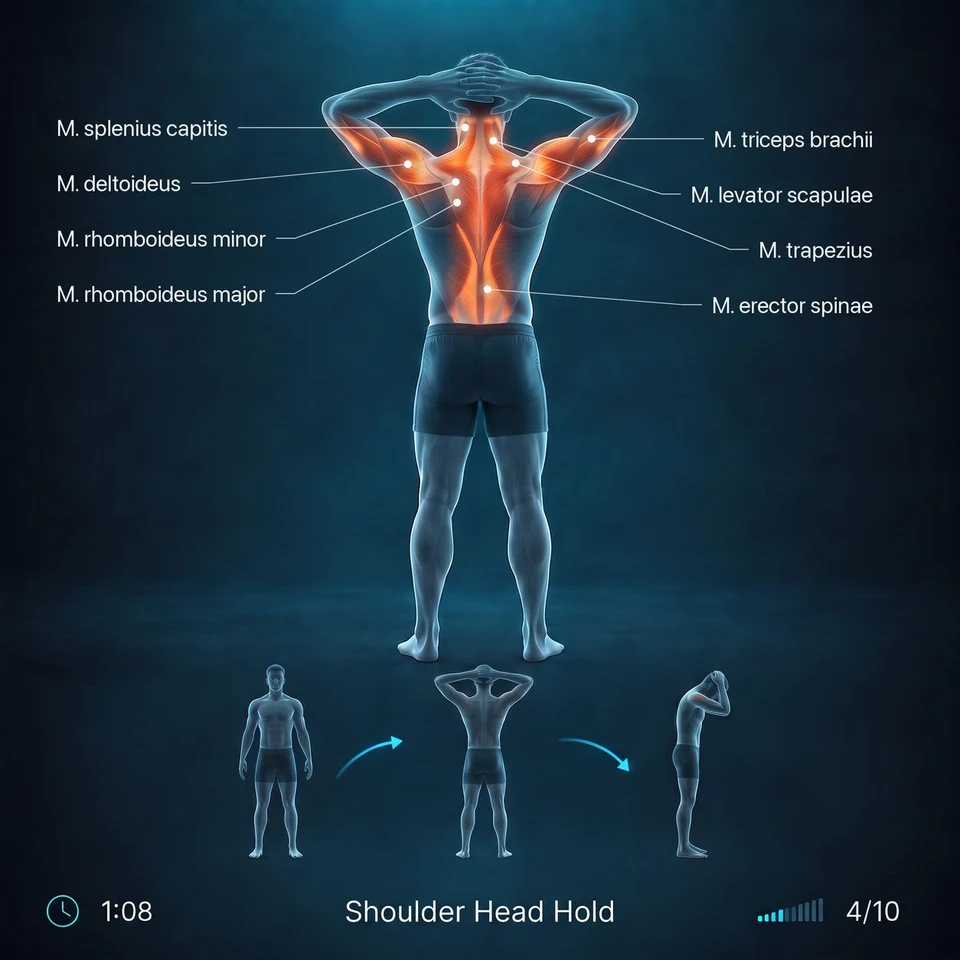
    Sit upright on a chair or bench. Place your hands behind your head with your fingers interlaced. Apply gentle pressure with the back of your head against your hands to feel slight tension in your neck.

  2. Hold the tension in your neck by gently pressing the back of your head against your hands.

  3. At the same time, draw your elbows back and down to lift the shoulder girdle.

  4. Hold this position without losing the tension in your neck.

  5. Make sure your shoulders are drawn back and down rather than pulled up.

  6. Breathe calmly and evenly throughout the exercise.
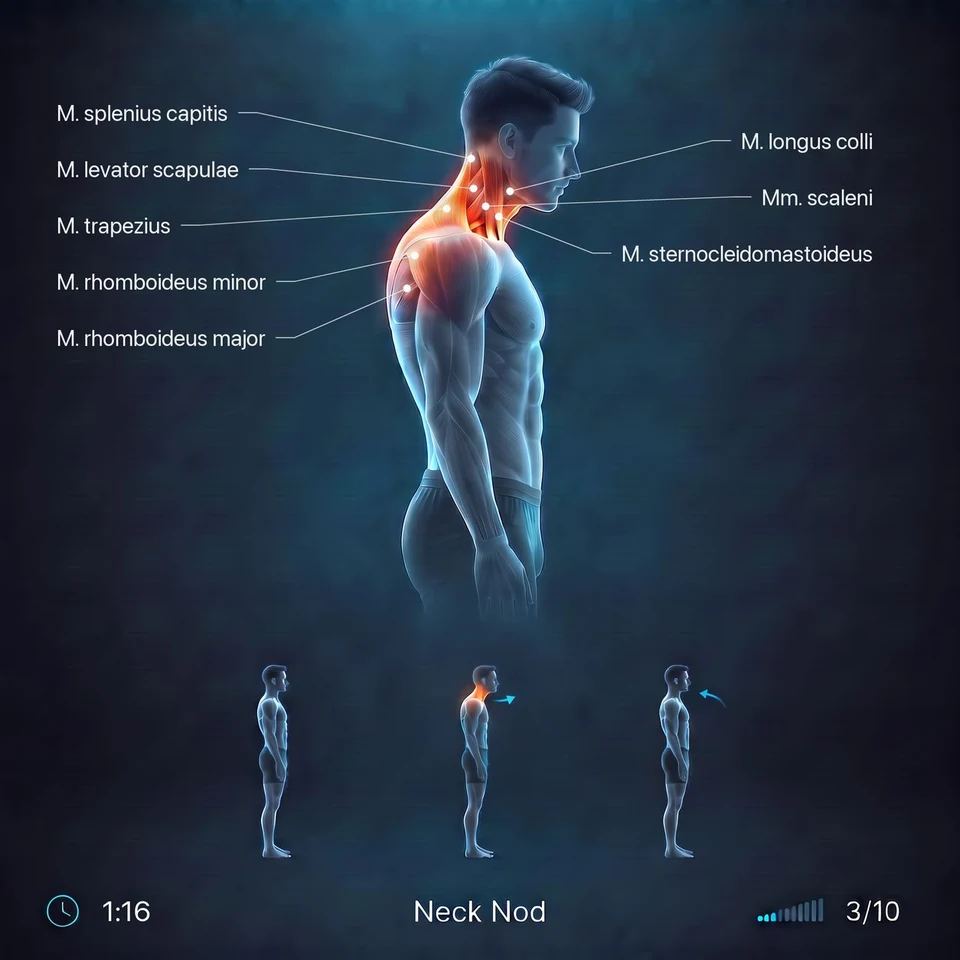
At a glance

Difficulty
4 of 10
Recommended duration
1 minute
Position
Seated
3D clip
01:22 min

Muscles trained

  • Trapezius (trapezius muscle)
  • Levator scapulae (shoulder blade lifter)
  • Rhomboideus major (major rhomboid)
  • Rhomboideus minor (minor rhomboid)
  • Deltoideus (shoulder muscle)

Description

Sit upright and clasp both hands behind your head. Apply gentle pressure with the back of your head against your hands until you feel slight tension in your neck. This stabilizes your cervical spine muscularly. Now lift your shoulder girdle by drawing your elbows back and down together, without losing the tension in your neck.

Tips

  • Be careful not to overextend your neck; the tension should be comfortable but noticeable.
  • Avoid pulling your shoulders up toward your ears.
  • Focus on gently drawing your elbows back and down to achieve good shoulder stability.

Variations

Harder
Add a light resistance band around your shoulders to challenge the muscles further.
Easier
Perform the exercise with less pressure of the back of your head against your hands and reduce the hold time.

Classification

Focus areas
Upper body, shoulders
Training name
Shoulder Head Hold Training

When to be careful

Skip this exercise or check with your doctor or physical therapist first if any of these apply to you:

  • Acute shoulder injuries
  • Severe shoulder joint instability
  • Uncontrolled muscle spasms in the shoulder
  • Recent surgery in the shoulder area
  • Acute pain during the exercise

What this exercise is intended for

  • Improved shoulder mobility
  • Conditioning for the neck
  • Improved posture
  • Loosening the shoulder muscles

Information from the Physio3D app exercise catalog — not a medical claim or promise of results.

Related exercises

This exercise in the app

All 50 exercises, plus training plans and your progress at a glance — free for iPhone, iPad, and Apple Vision Pro.

Physio3D is a supportive training tool and does not replace medical advice, diagnosis, or therapy. If you have any health concerns, please consult a doctor or physical therapist.

Exercise

Physio3D is a supportive training tool and does not replace medical advice, diagnosis, or therapy. If you have any health concerns, please consult a doctor or physical therapist.