Upper Back

Upper Back Opener

  • 1:15 min
  • 🔊 Voice guidance
  • AR AR available
  • Seated

Upper Back Opener: Starting position: Seated. The public 3D demo shows the recorded movement with voice guidance.

Before you start · Supports your training. No individual suitability assessment.

This exercise is demonstrated seated. Use a stable chair.

The exercise in detail

The thoracic spine and shoulder girdle are guided calmly through the movement shown; the 3D coach sets the alignment and pace.

How the exercise works

  1. Starting position

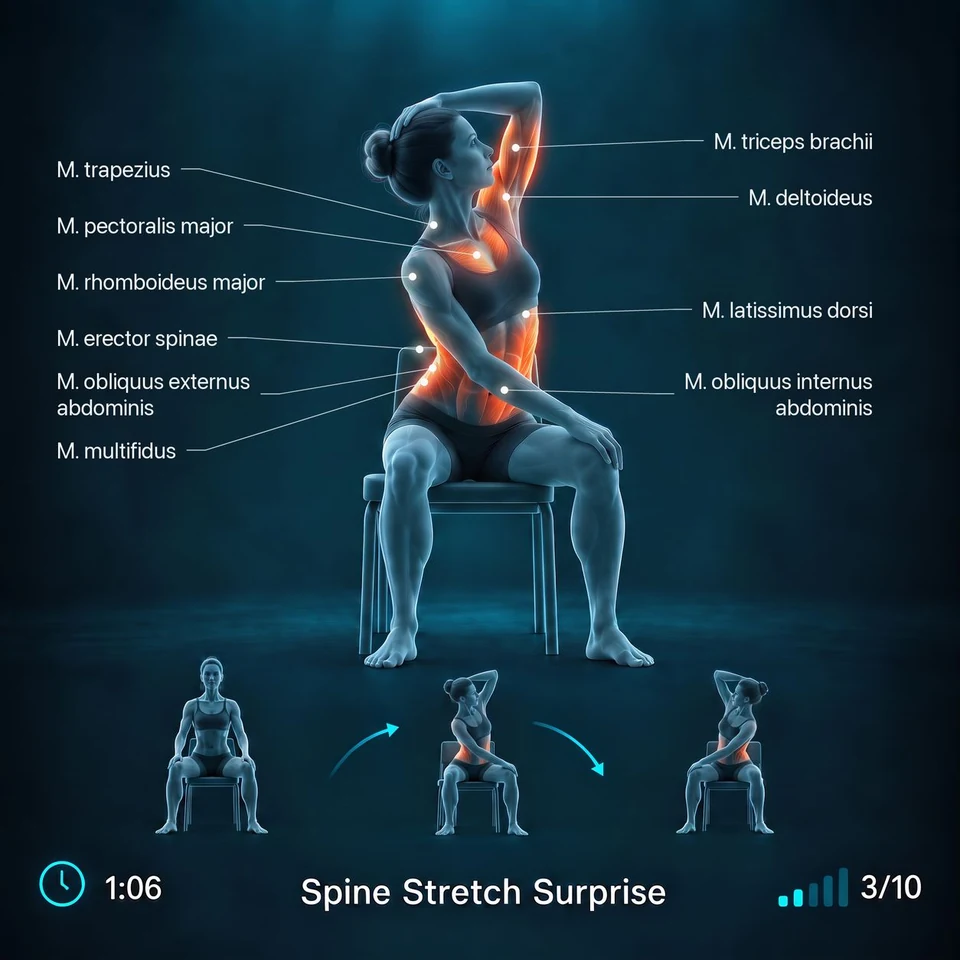
    Sit upright on your chair with your legs wide apart. Rest your elbows on the insides of your thighs near the knees.

  2. Slowly raise your left elbow toward the ceiling and follow it with your gaze.

  3. Feel the stretch along the left side of your trunk and in your chest.

  4. Breathe in and out deeply and evenly.

  5. Hold the position for about 30 seconds to 1 minute.

  6. Repetitions

    Repeat the exercise five times.
At a glance

Difficulty
3 of 10
Recommended duration
1 minute
Position
Seated
3D clip
01:14 min

Muscles trained

  • Obliquus externus abdominis (external oblique)
  • Obliquus internus abdominis (internal oblique)
  • Erector spinae (back extensor)
  • Multifidus (deep spinal muscle)
  • Latissimus dorsi (broad back muscle)

Description

Sit on your chair with your legs wide apart and rest your elbows on the insides of your thighs near the knees. Now raise your left elbow toward the ceiling and follow it with your gaze until you feel a comfortable stretch along the left side of your trunk and in your chest.

Tips

  • Keep your back straight throughout the exercise.
  • Avoid leaning too far to the side — the stretch should feel comfortable, not painful.
  • Focus on deep, even breathing to relax the muscles.

Variations

Harder
Perform the exercise standing by supporting one hand on your thigh and reaching the opposite arm toward the ceiling. This deepens the stretch and demands more stability.
Easier
Reduce the rotation and perform the movement more slowly to make the stretch gentler. Hold the position for only a few seconds before switching sides.

Classification

Focus areas
Upper back, upper body
Training name
Upper Back Opener Training

When to be careful

Skip this exercise or check with your doctor or physical therapist first if any of these apply to you:

  • Acute back injuries
  • Severe spinal instability
  • Uncontrolled muscle spasms in the back
  • Recent surgery in the back area
  • Acute pain during the exercise

What this exercise is intended for

  • Improved trunk mobility
  • Conditioning for the back
  • Improved posture
  • Loosening the trunk muscles

Information from the Physio3D app exercise catalog — not a medical claim or promise of results.

Related exercises

This exercise in the app

All 50 exercises, plus training plans and your progress at a glance — free for iPhone, iPad, and Apple Vision Pro.

Physio3D is a supportive training tool and does not replace medical advice, diagnosis, or therapy. If you have any health concerns, please consult a doctor or physical therapist.

Exercise

Loading character …

Physio3D is a supportive training tool and does not replace medical advice, diagnosis, or therapy. If you have any health concerns, please consult a doctor or physical therapist.

Exercise

Physio3D is a supportive training tool and does not replace medical advice, diagnosis, or therapy. If you have any health concerns, please consult a doctor or physical therapist.