Spine

Hip Flexor Lunge Stretch

  • 2:22 min
  • AR 3D / AR in the apps

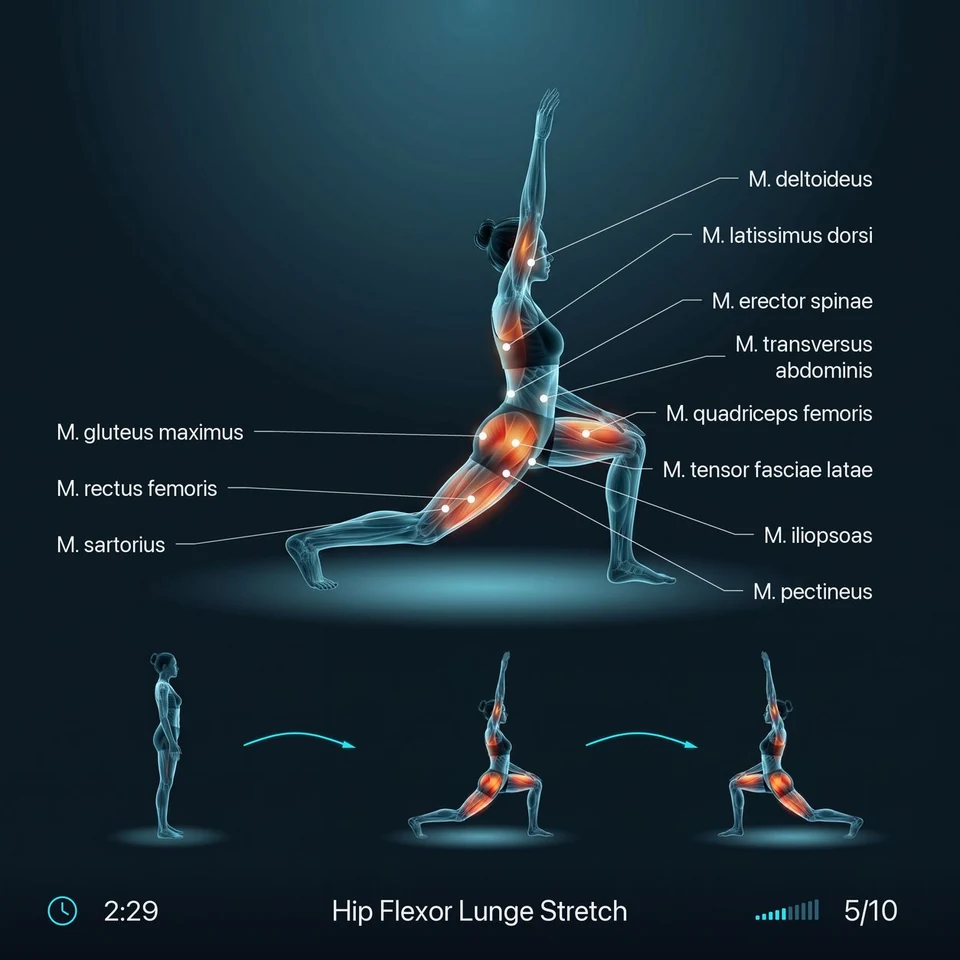
Hip Flexor Lunge Stretch: Starting position: Standing. The full 3D and AR demonstration is available in the Physio3D apps. Read the exercise instructions here.

Before you start · Supports your training. No individual suitability assessment.

Find this exercise in 3D and AR in the Physio3D apps. Read the instructions and exercise information here. Find your app

The exercise in detail

The spine is guided through its natural directions of movement — bending, extending, or rotating, always slow and controlled.

How the exercise works

  1. Starting position

    Stand upright with your feet hip-width apart and engage your abdominal muscles to ensure a stable core position.

  2. Take a large step back with your right foot so that you move into a lunge position.

  3. Straighten your right knee and slowly lower your pelvis toward the floor.

  4. At the same time, raise your right arm toward the ceiling to deepen the stretch in the hip flexor of your right groin.
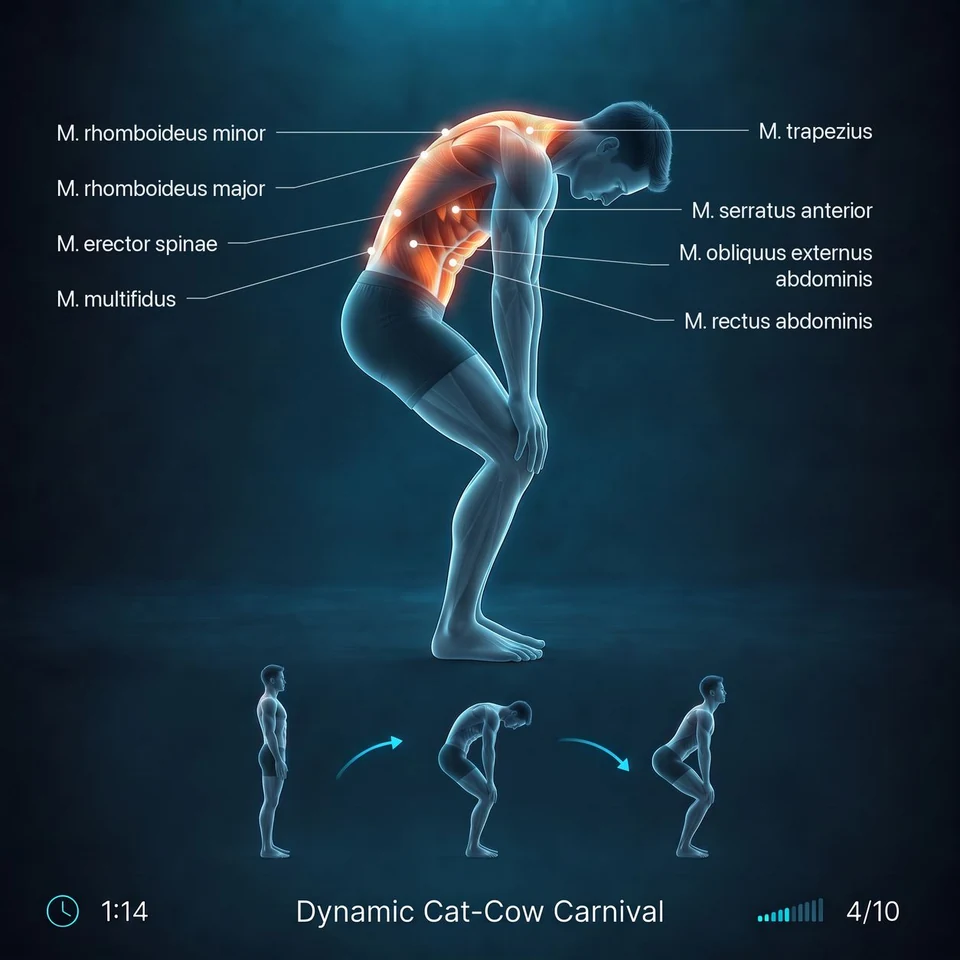
At a glance

Difficulty
5 of 10
Recommended duration
1 minute
Position
Standing
3D clip
02:21 min

Muscles trained

  • Quadriceps femoris (front thigh muscle)
  • Gluteus maximus (large gluteal muscle)
  • Erector spinae (back extensor)

Description

This exercise aims to stretch the hip flexors and improve hip mobility. It also promotes core stability and can help release tension in the hip area.

Tips

  • Make sure your front knee does not extend past your toes.
  • Keep your upper body upright and avoid arching your lower back.
  • Engage your abdominal muscles to increase stability during the stretch.

Variations

Harder
Increase the intensity by lowering your pelvis as close to the floor as possible to deepen the stretch.
Easier
Reduce the stretch by stepping back a shorter distance and keeping your knee slightly bent to lower the load.

Classification

Focus areas
Trunk, lower body, pelvis
Training name
Hip Flexor Lunge Stretch Training

When to be careful

Skip this exercise or check with your doctor or physical therapist first if any of these apply to you:

  • Acute hip injuries
  • Severe hip joint instability
  • Uncontrolled muscle spasms in the hip area
  • Recent surgery in the hip area
  • Acute pain during the exercise

What this exercise is intended for

  • Improved hip mobility
  • Conditioning for the hips
  • Improved core stability
  • Loosening the hip muscles

Information from the Physio3D app exercise catalog — not a medical claim or promise of results.

Related exercises

This exercise in the app

All 50 exercises, plus training plans and your progress at a glance — free for iPhone, iPad, and Apple Vision Pro.

Physio3D is a supportive training tool and does not replace medical advice, diagnosis, or therapy. If you have any health concerns, please consult a doctor or physical therapist.

Exercise

Physio3D is a supportive training tool and does not replace medical advice, diagnosis, or therapy. If you have any health concerns, please consult a doctor or physical therapist.